
"Is simple for me"
On Leonor Fini and "Heated Rivalry"

The MET Gala took place on Monday, and I wanted to write about this year’s art history—and cinematic—themes, but I am keenly aware of a conflict of interests and so needed to write about something else for you. So, I’ve made good on a threat to my nearest and dearest and decided to bring my new favourite television show (and boys) into the fold.
Since Sky TV aired the show in January of this year, my Instagram feed, brain, and headspace have been filled with all things “Heated Rivalry”. This is not conducive to a woman in her early forties who has other things to do, but when you are seeing stills and interviews and clips and reels and—my favourite, good edits—every time you open IG, TikTok, and Threads, you begin to transpose certain scenes onto different images and artworks you are otherwise familiar with.
[SPOILERS FOR HEATED RIVALRY AHEAD!]
For those few unfamiliar with the show, it’s about two young hockey players—Canadian Shane Hollander (Hudson Williams) and Russian Ilya Rozanov (played by Texan Connor Storrie)—the two best players in the league, who play for teams with a historic rivalry. From the age of seventeen when they are drafted, they are immediately pitted against one another—by the media, by their teammates, by their families. Yet sparks fly the first time they meet, an unspoken curiosity and desire, and they spend the better part of a decade in a prolonged secret situationship, hooking up whenever their teams meet, while denying their intense feelings for one another. After an event where feelings can no longer be contained causes a rupture and distancing (something fans have dubbed the “Tuna Meltdown” of episode four), they find their way back to each other; in bringing down their walls, they grant themselves the means and honesty necessary to move their future forward. The show, based on Rachel Reid’s immensely popular books (I inhaled all six in less than three months), has spawned a rabid fandom or a cult, depending on who you talk to. Sure, sex is a key part of “Heated Rivalry” , a form of dialogue between the leads, but a show cannot hinge only on sex—here we have desire, stolen glances, tear-filled eyes that tell an entire story. I don’t think the series would have hit so hard without the potent chemistry of the immensely likeable and beautiful leads, who shatter stigmas of masculinity with their on-screen consent, care, and tenderness, and off-screen best-friend affection. It burned slowly for me (I tell myself) as the episodes played out, but the moment it hit (the end of episode two, I think?) I was infatuated.
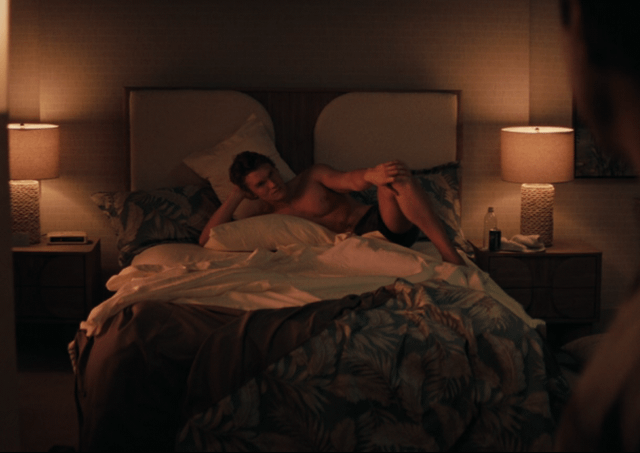
I’ve teased that I’ll write about the show at some point, and wasn’t really sure I would, but scrolling my IG feed this week and seeing yet another screengrab of a certain scene, I finally realised what it reminded me of. In Ep5, Ilya reclines on what can only be described as a “torn-up bed”, the boys having rekindled their relationship after months apart. Ilya is reclining on the bed, one leg bent in a classical art history pose, his face, as if carved by Michelangelo at the best of times (Storrie is seriously one of the most beautiful young actors working right now—a literal artwork [sorry!]), looking like a cross between David and Achilles. As Shane and Ilya exchange goodnights, Ilya’s resigned face shows, and knows, their almost decade of trysts are not “simple”, contradicting what he had previously said to Shane an hour or so earlier, kidding himself that he isn’t madly in love: “Is simple for me”.
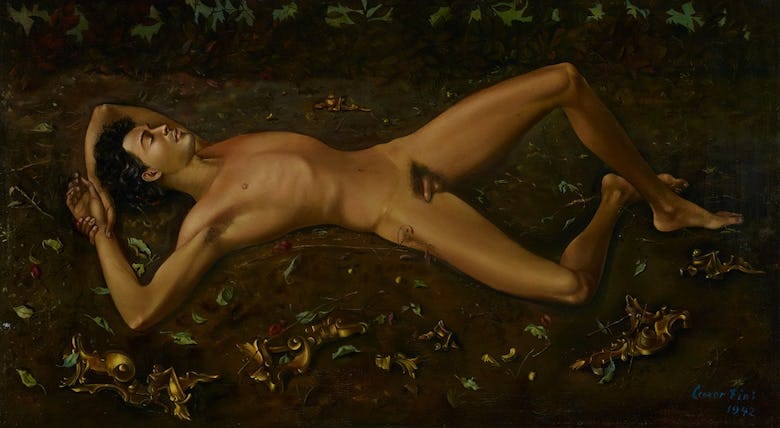
Anyway, I finally realised what the pose—the moment—and the screenshot reminded me of: Leonor Fini’s nude portraits.
One of these paintings is of Nico Papatakis, a blue-eyed half-Ethiopian young man Fini first met at a dinner party in pre-war Paris held by her friend the Vicomtesse de Noailles (a distant relative of the Marquis de Sade who helped finance works including Luis Buñuel’s L’Age d’Or and Jean Cocteau’s Blood of the Poet). Papatakis became one of Fini’s favourite models—he later settled in Paris, opening the La Rose Rouge nightclub in St. Germain, which became a favourite haunt of Jean Genet, Juliette Greco, and other like-minded personalities. Papatakis was the subject of Fini’s Portrait romantique (1941), which her biographer Peter Webb describes as “one of her most natural and appealing portraits of the period.” Nu (Male Nude, 1942) depicts Papatakis reclining in a landscape, nude, with his arms over his head, and face content. It’s a portrait of both peace and vulnerability.
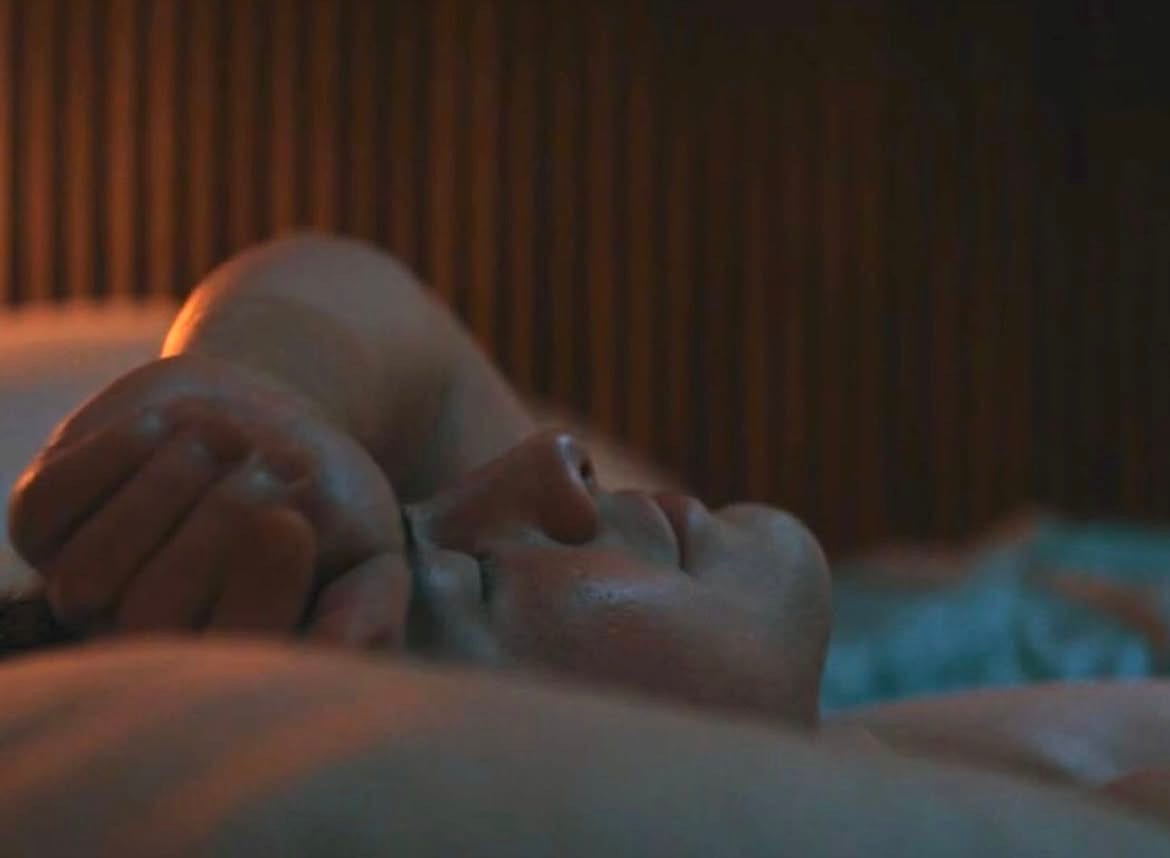
Webb mentions Papatakis’ memoirs, “Tous les désespoirs sont permis” (All Anguish Allowed), and the embarassement he felt at being asked to pose in the nude, “stretched out in Leonor’s living room on her sofa covered with Florentine fabric and prey to (unfounded) fears that she might expect sexual favours as well”, but got a kick out of the leafy setting Fini had created (which, incidentally, was not unlike some of Fini’s skull and bone paintings). In many ways, his face resembled Shane’s blissed-out look after he loses his virginity to Ilya in episode two.
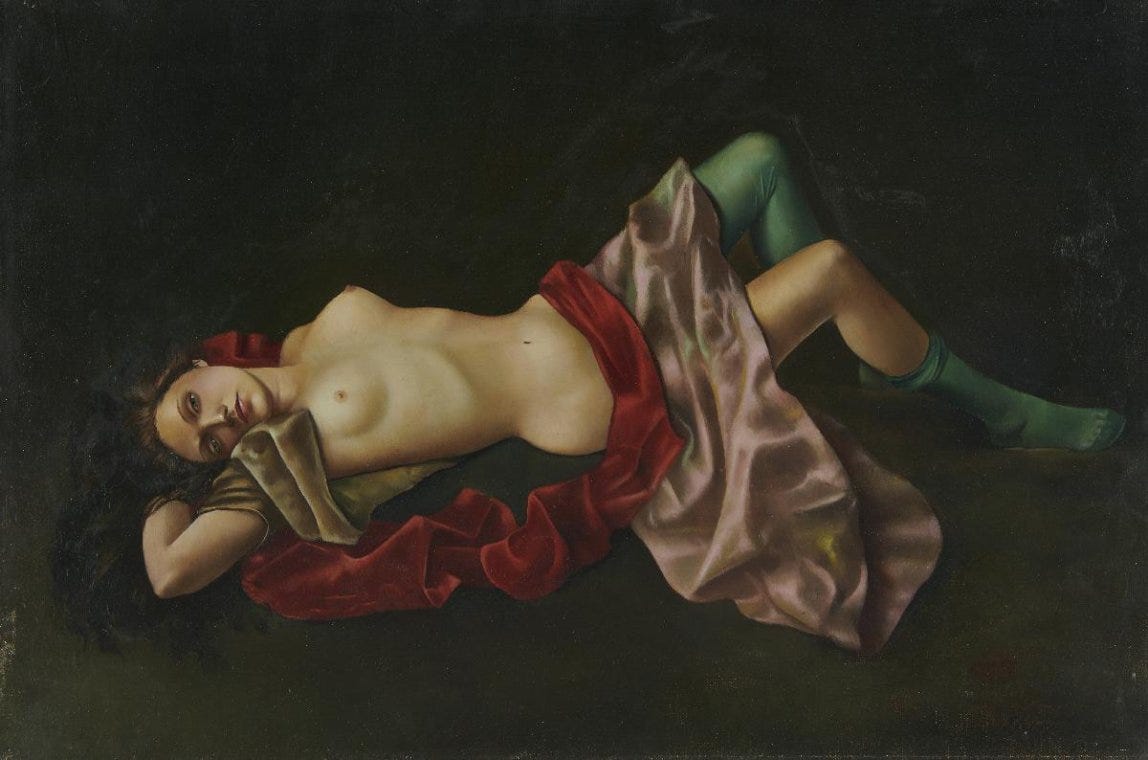
Fini also created a companion piece, Nu (Female Nude, 1941), of a girl in a similar pose, her breasts exposed and lower half covered, but her head turned as if to look directly, challengingly, at the viewer. Both paintings were purchased and gifted to the Musée d’Art et d’Histoire in Geneva.
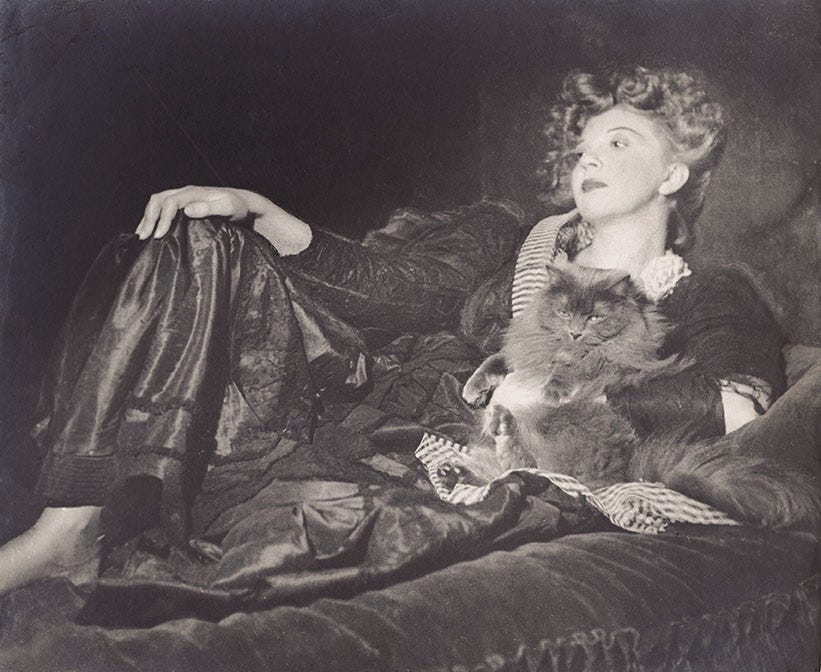
Additionally, we have this photograph [top of page] of Fini with Moutchi, one of her cats, another image I cannot help but compare and see a similarity.
I’m sure there are other art references dotted around the series, and maybe I’ll write about them too at some point if my loved ones haven’t disowned me by then. I might as well turn this obsession into something productive. Yes, I think so, probably.
P.S. I am currently running a discount on paid subs, so now is your chance to subscribe for £3.50 per month!