
Keeper
Conjurings

Last week, I left the house on a chilly Thursday evening to watch Keeper, the latest offering from Osgood Perkins, where nothing especially happens for most of the film, until everything happens before the cinema’s lights come back on. In the movie, a couple takes a trip to his family’s cabin for their first anniversary, a romantic getaway that is fraught with weird energy and strange goings on. (If it had been me, I would have been shouting “VIBES ARE OFF!” and hightailing it out of the place). There’s also something about chocolate cake that’s put me off the delicious treat for the time being. I must say, I was somewhat intrigued and think it’s the best of OP’s recent crop of work. What most impressed me was the imagery when shits gets real, which—without getting all spoilery—really reminded me of the works of Leonora Carrington, Kati Horna, and Remedios Varo.
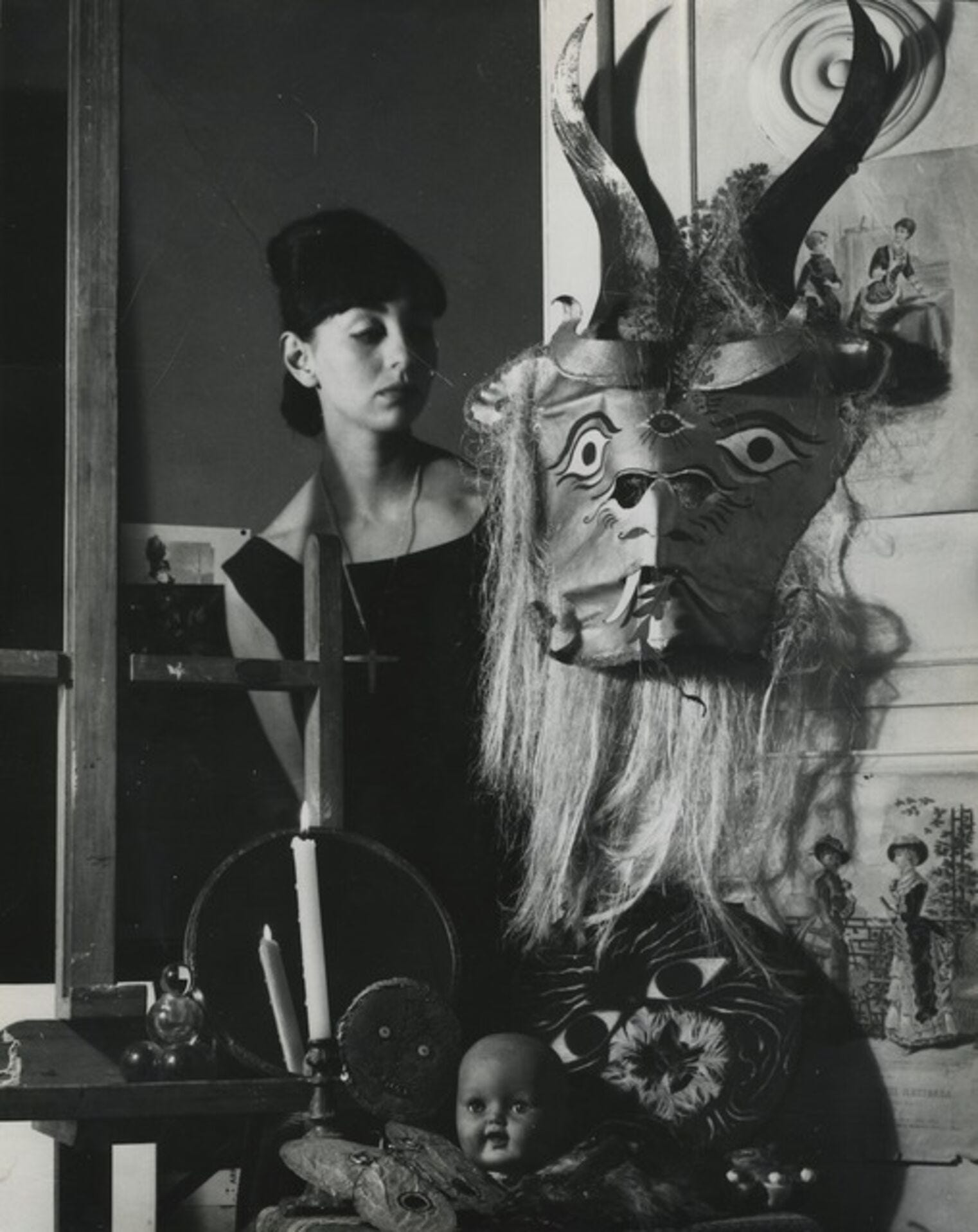
One striking scene evoked photographs of Remedios Varo taken by Kati Horna. In the black and white picture, Varo wears a mask made by Carington, their mutual friend. The front of the mask is hollow, allowing us to see Varo, and in the photos of her in profile, we can clearly see another face on her right side. It makes sense if you have seen Keeper, trust me.


While both Carrington and Varo’s art was situated in alternate, otherworldly places, Horna’s work was mainly documentary. The Budapest-born photographer, who made Mexico her home and is regarded as one of the most influential war photographers, was among the few women documenting the front lines of the Spanish Civil War. Horna called herself an “art worker” rather than an artist, yet the avant-garde was a constant thread throughout her life, and the uncanny would often creep into Horna’s work. Her 1962 Untitled series Oda a la necrofilia was created during a period of great creative experimentation, and marked Horna’s first contribution to the ‘Fetiche’ section of S.nob magazine, a short-lived but influential Surrealist publication edited by the cult writer Salvador Elizondo. The haunting series featured Carrington in a variety of stances and poses; the sensuality and darkness of the domestic.
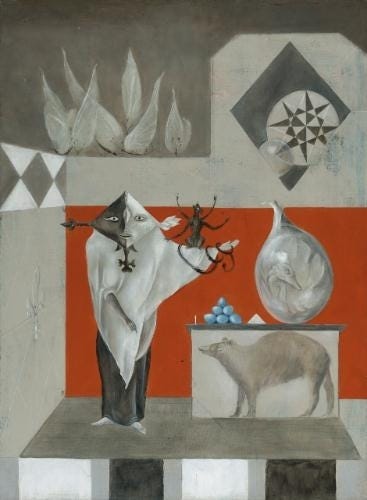
The Conjurer is another such rendering. Created in 1960 by Carrington, the dreamlike symbolism, the enigmatic figure, and the shape of the protagonist’s face are very in keeping with Perkins’ vision. In the painting, we see blue glass orbs on a table, geometric patterns, what appears to be a goat, a chessboard (chess being a recurring motif in Surrealism)—all serving to heighten the spectralness of the scene we are seeing—on screen and off—and everything brought forth by this benevolent, smiling being. Given the cabin in Keeper, and what is contained within the house and the forest, I wonder if Perkins referred to the image as a notable point of reference.
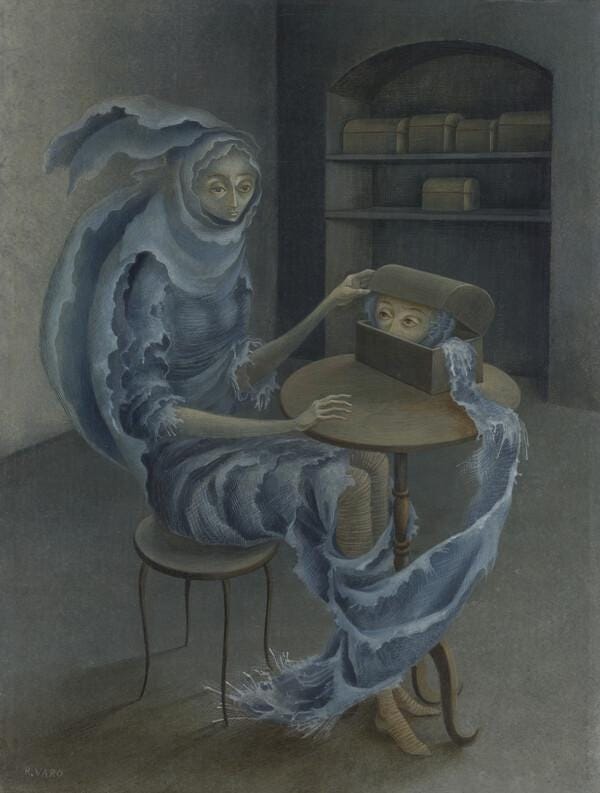
The final image that came to mind was Varo’s Encounter, created at the height of her career in 1959. Encounter is a work that embraces “chance encounters”that so fascinated the Surrealists, whether the enigmatic Nadja on the Paris streets, or in their work (Lee Miller and the Rayograph). The painting shows a seated figure wearing what appears to be a wavy blue cloak—quite literally made of sea waves. She tentatively lifts the lid off a small box or chest on the table in front of her, which reveals her own eyes staring back at her. Around her in the room are multiple identical boxes, concealing what part of her, we do not know. We only know that they are there, waiting to be discovered.
I did not make these connections. This is why I subscribe. Thank you.
I appreciate the impulse here—the genuine pleasure of walking out of a movie theater on a cold night with your head full of images that won't behave, that insist on connecting themselves to other things you've seen, other worlds you've wandered through. There's something honest about this kind of associative drift, the way a scene from Osgood Perkins suddenly calls up Kati Horna, and you're off down the rabbit hole of masks and mirrors and women who knew how to traffic in the genuinely strange.