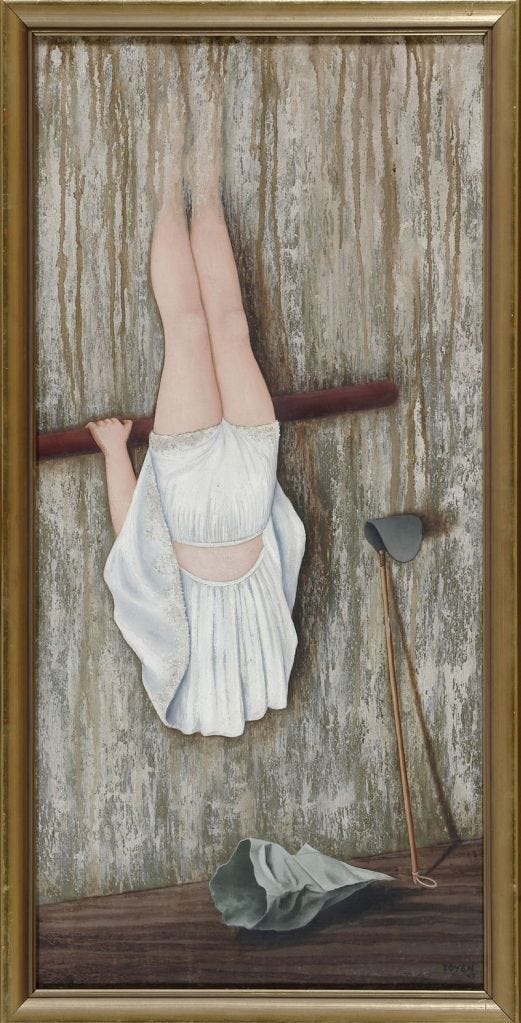
Relâche
[After the Performance]

![the-shooting-gallery-xii-1940[1]](https://substackcdn.com/image/fetch/$s_!9Aff!,f_auto,q_auto:good,fl_progressive:steep/https%3A%2F%2Fsubstack-post-media.s3.amazonaws.com%2Fpublic%2Fimages%2F7231be47-9866-4c26-aaa5-b65f37d994b6_656x474.jpeg "the-shooting-gallery-xii-1940[1]")
It wouldn’t be a surprise to reveal that the Surrealists admired Lewis Carroll’s Alice in Wonderland, with its fantastical themes and dream logic. One of the most effective interpretations of the book on screen wasn’t the Disney version of 1951, or Tim Burton’s 2010 version (we won’t mention the sequel), but Czech animator Jan Švankmajer’s Alice or Něco z Alenky (“Something from Alice”). The stop motion animation — smooth and rapid and stripped of the saccharine sweetness of Disney’s version of the ‘50s — is a darkly bewitching piece of work.
Alice in Wonderland has made appearances in other forms. David Lynch’s Mulholland Drive — much of Lynch’s work, in fact — could be thought of as a Hollywood interpretation, with the ingenue Betty tumbling down the rabbit hole to find herself in what she initially thinks is a Wonderland, but where there’s Winkie’s diner instead of Mad Hatter Tea Parties.
I’ve written about the versions of Alice in Surrealism before, mainly in a previous piece about Alice Rahon, who went “through the looking glass” in Mexico, so to speak. But another artist who depicts the darkness of Carroll’s original tale is Toyen, whose sketches I visited at London’s Richard Saltoun Gallery a couple of weeks ago. Toyen — described by André Breton as having “a face medalled with nobility” — was born Marie Čermínová in Prague (like Švankmajer) in 1902, and adopted a gender neutral identity at a young age. They met Breton in 1935 when he visited Prague with the poet Paul Eluard; the previous year Toyen had designed the cover for the Czech edition of Breton’s 1932 book “Communicating Vessels” (“Les Vases communicants”). Breton became a great admirer of Toyen’s work, writing the preface to their first solo exhibition at Paris’ Galerie Denise René in 1947. After Breton’s death, Toyen moved into his former studio at 42 Rue Fontaine, where they lived until their passing in 1980.
Much of Toyen’s imagery evokes and alludes to the horrors of war — as seen in their dark, Carroll-like series “The Shooting Gallery” (1939-1941) — and even 1943’s Relâche [After the Performance], in which a balletic and gymnastic “through the looking glass” pose can evoke equal amounts of play at the park (who didn’t try to spin themselves over a bar in the playground?) or a game of childhood play gone foul (the suspension, the figure’s disappearance into the wall, the empty bag and fly swatter propped against the wall where a substance appears to drip down) — but their collaborations with Jindřich Štyrský are charged with eroticism and humour, and a queer, non-binary perspective on Surrealism. These works, appearing across visual art, book designs, photography, and avant-garde publishing, were a key component of Czech Surrealism and both artists’ development. Under the imprint “Edice 69” (1931-32), they produced a series of underground erotic books which challenged the boundaries between image and text, and, in true surrealist fashion, provoked bourgeois morality and ideology.
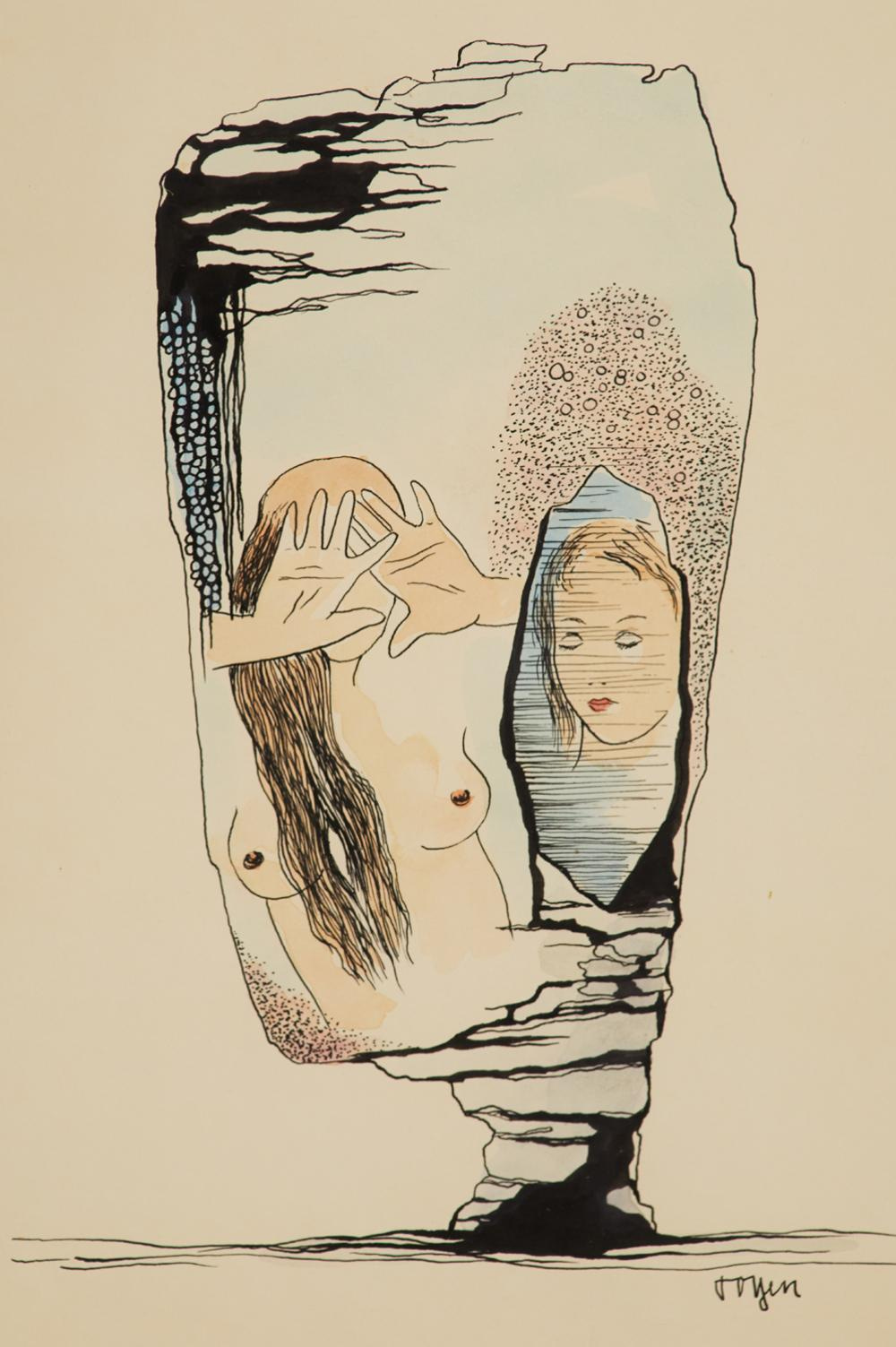
A few pals who saw the exhibition expressed their love for Toyen’s erotic drawings, and it’s easy to understand why. There’s so much sadness and war raging in this world, but these sketches — filled with eroticism and Surrealist resistance, humour and even sweetness, in tones of pink and blue and green — appear so light and playful while saying so much, and we need more of that at this moment in time.